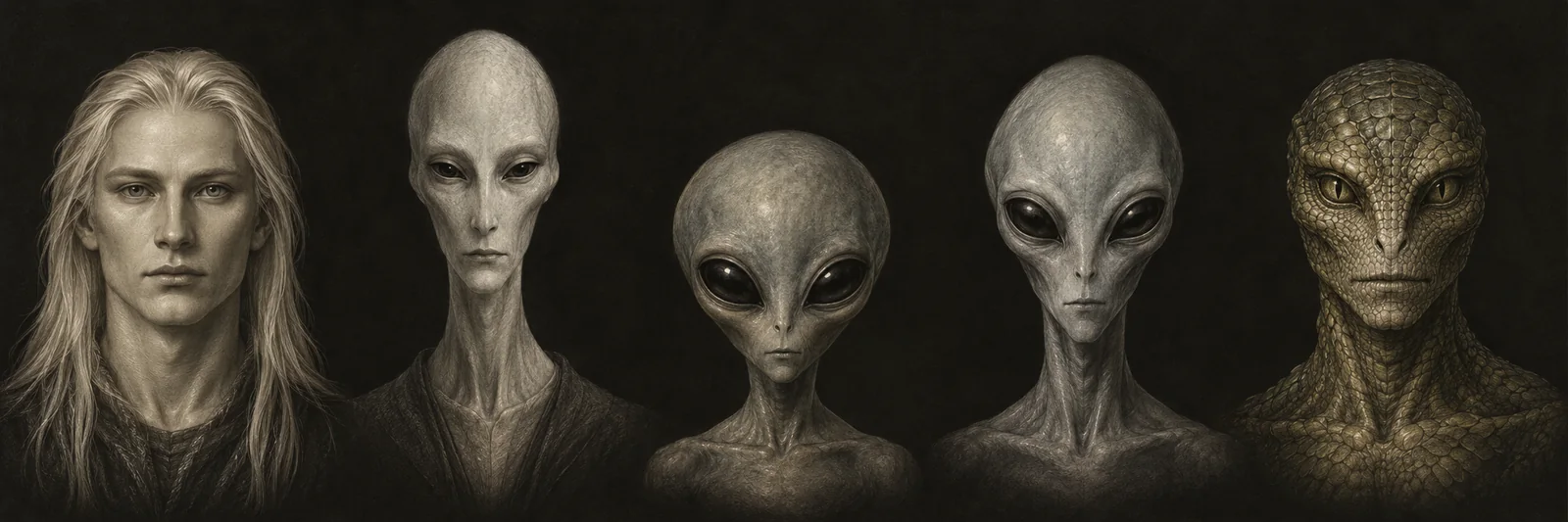
This entry documents a motif and its sources. It does not establish an alien species, home world, anatomy or capability.
“Grey” is a broad name used in encounter literature and popular imagery. Readers often recognize the large-eyed, lightly built humanoid immediately. What the name does not provide is a standardized definition. “Regular Grey” is especially informal: it should not be presented as a scientifically established category separate from the Short Greys.
How this guide uses the label
On this site, the general Greys entry is the overview. The Short Greys entry focuses on reports that emphasize small stature. This is an editorial navigation choice, not a claim that two populations have been demonstrated. A clear note between the pages prevents a visual catalogue from suggesting more precision than its sources support.
Descriptions and their sources
The strongest starting points are dated records and identifiable collections. The University of New Hampshire's Hill archive offers actual correspondence, manuscripts, and objects for studying one influential encounter account. University reporting on abduction narratives describes recurring visual features. Together, these sources support a history of reported imagery. They do not establish an extraterrestrial anatomy, a place of origin, or a division of roles among different sizes of beings.
Readers should also distinguish a witness's words from what later illustrators and storytellers add. A polished modern portrait may combine details from several accounts. A page can still use that portrait, provided the caption makes its illustrative purpose plain and the surrounding text names the source tradition.
We use the Grey label as a route into that record. Claims about telepathy, medical examinations, hybrid programs, or command hierarchies need their own named sources and evidence assessments. They should not be attached automatically to every image that shares the familiar face. Keeping the label flexible lets the archive remain useful without creating a fictional scientific certainty.
Follow the sources
- University of New Hampshire: Betty and Barney Hill collection Archival material documents the account; the archive does not authenticate alien contact
- University of Queensland: reporting on abduction research August 18, 1998; study of reported experiences
- NASA UAP frequently asked questions Official scientific evidence context; checked October 12, 2026
Source check: October 12, 2026. Linked material establishes only the claims described in its source note. Official attribution and publication do not eliminate uncertainty. Read our editorial standard.